| Impact | Reshaping geopolitics • Transforming economics • Redefining the nature of space travel and colonization |
| Propulsion | Warp drive • Quantum tunneling engine • Hyperdrives |
| Innovations | Revolutionary propulsion technologies • Advanced, lightweight materials |
| Capabilities | Faster-than-light travel • Unprecedented interstellar exploration • Transformative impact on human civilization |
| Vehicle Type | Futuristic FTL spacecraft |
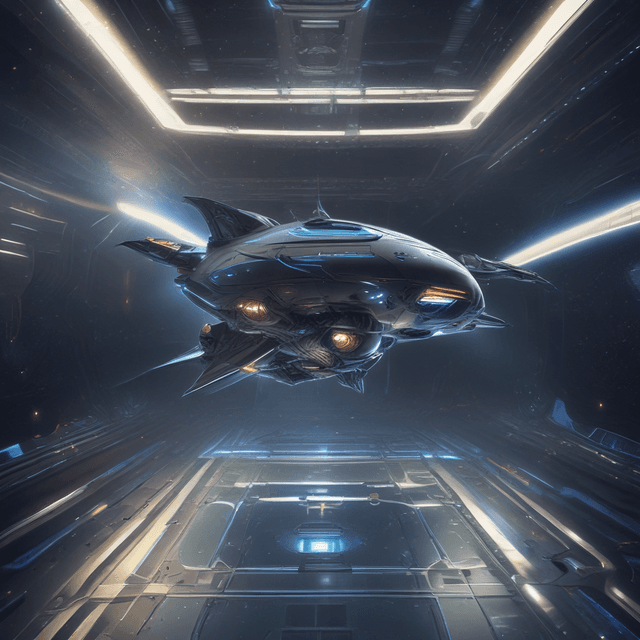
In a remarkable scientific breakthrough, humanity in this timeline has conquered the barrier of lightspeed, unlocking the potential for faster-than-light (FTL) travel. This paradigm shift, driven by innovations in theoretical physics, exotic matter manipulation, and advanced engineering, has ushered in a new era of futuristic vehicles capable of defying the traditional limits of space exploration.
Among the most advanced FTL propulsion systems to emerge are warp drive engines, which leverage the manipulation of spacetime itself to achieve superluminal speeds. By creating a "warp bubble" that contracts space in front of the craft and expands it behind, warp drives effectively "surf" the curvature of spacetime, allowing them to exceed the speed of light.
Warp-capable starships, like the experimental IXS Enterprise and the production-model Pioneer-class Intersteller Cruiser, can traverse vast interstellar distances in a matter of hours or days, making routine trips to nearby star systems practical. These vessels utilize powerful matter-antimatter reactors to fuel their warp drives, as well as advanced life support, scientific laboratories, and automated construction and repair capabilities.
An alternative FTL approach involves quantum tunneling, where specialized propulsion systems leverage quantum mechanical effects to "tunnel" through space-time barriers. Quantum Slipstream Drive equipped craft like the Interceptor-class Rapid Response Ship are able to dart between locations faster than light by briefly compressing the space-time continuum.
Quantum tunneling vessels sacrifice the sustained faster-than-light speeds of warp drive ships, but can achieve incredibly rapid, short-range "hops" that make them ideal for tasks like planetary exploration, emergency response, and military interdiction. Their power systems are also generally more compact and efficient than warp drives.
For more practical, large-scale cargo and passenger transport, "hyperdrive" systems have emerged as a middle ground between warp and quantum tunneling. Hyperdrives create a localized hyperspace dimension that the craft can "jump" into, allowing for faster-than-light travel through this alternate realm before re-emerging at the destination.
Hyperspace-capable freighters, bulk carriers, and luxury liners can efficiently move vast quantities of goods, resources, and people between settlements and colonies across the solar system and even between nearby stars. The Lightwave-class Interstellar Hauler and Horizon-class Passenger Liner are two prominent examples of such hyperdrive-equipped transport vessels.
The advent of practical FTL travel has had profound societal impacts, transforming human civilization in this alternate timeline. Interstellar colonization and resource extraction have accelerated, with Mars, the Jovian Moons, and distant exoplanets now home to thriving off-world communities. Global trade and cultural exchange have become instantaneous, and the space economy is now a major driver of prosperity.
However, these technological breakthroughs have also introduced new geopolitical tensions, as nations and corporations vie for control of vital hyperroutes, colony worlds, and exotic matter resources needed to power their FTL drives. Concerns over the potential military applications of warp and quantum technologies have also sparked arms races and heightened security measures.
Nonetheless, the promise of faster-than-light travel remains a cornerstone of humanity's future in this timeline. As we continue to push the boundaries of the possible, ever more ambitious feats of interstellar exploration, settlement, and even terraforming lie within reach. The stars, once unreachably distant, are now mere steps away.
